
How to Search Criminal Dockets
Figure out the court before typing a name into anything. Felony cases sit in the 77th or 87th District Court. The Freestone County District Clerk keeps those files. Class A and B misdemeanors run through the constitutional County Court and its County Clerk. A Class C charge or a traffic ticket may belong to a justice court. It may instead belong to the municipal court named on the citation. One empty search does not mean no case exists.
The county's official Court Dockets index posts dated PDF lists. It offers no one universal name-search form. An exact cause number works best. Check any notice, bond paper, citation, or old order for the court and number. The PDFs themselves warn that settings can change.
- Identify the court from the charge level and notice.
- Open the matching PDF, court page, or state portal.
- Search for the exact cause number or case style.
- Record the court, date, time, and setting label.
- Call the clerk or coordinator for status and copies.
re:SearchTX has Cases, Filings, Text, and Hearings modes behind an eFileTexas account. Coverage varies by court. The state's broad document collection leaves out criminal case records, so it cannot replace the local clerk.
Freestone Felonies Start District
A felony lookup starts with the District Clerk. Call the district court coordinator at (903) 389-4836 for practical setting questions. For the case record itself, turn to the District Clerk at (903) 389-2534. That office handles filings, jury matters, and copies. The judge controls each setting, while the clerk keeps the docket and every filed paper. The official District Clerk source names the office and its criminal record contacts.
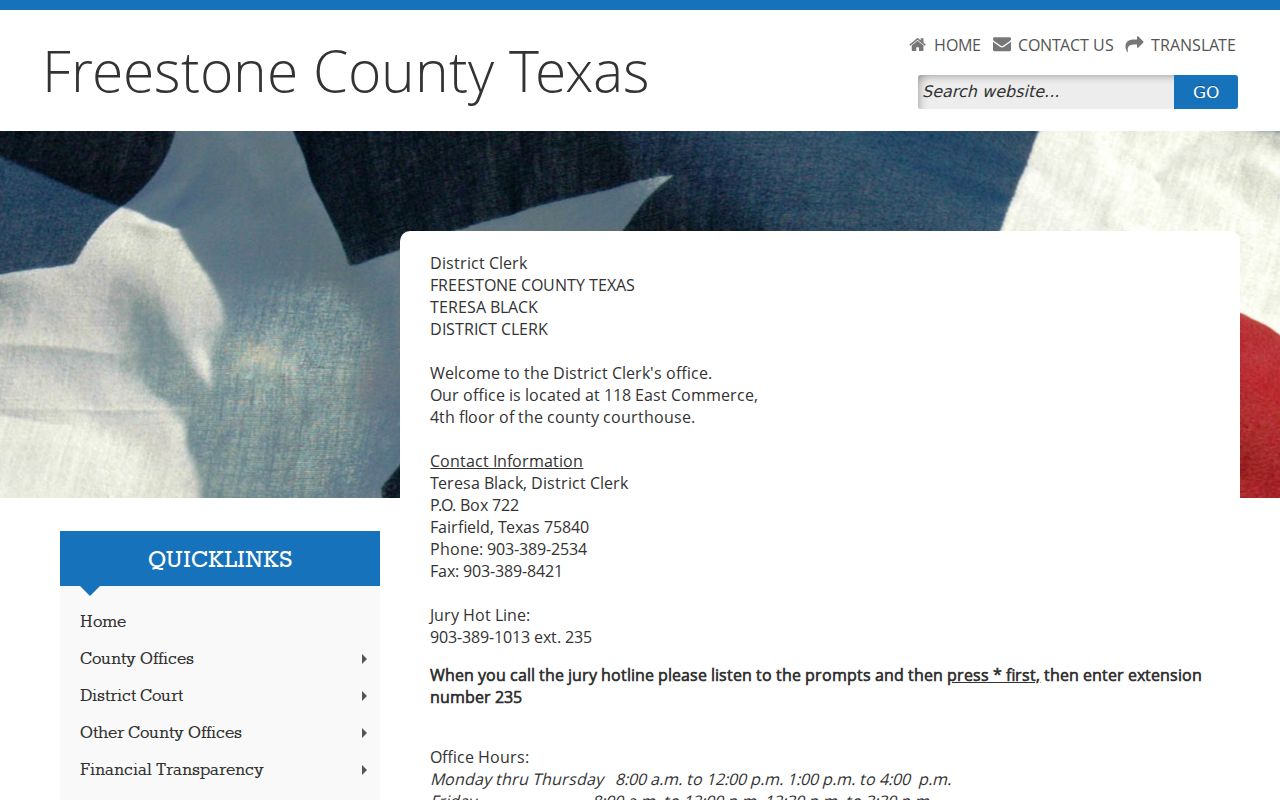
The image supports the district route for felony files, certified copies, and docket questions.
Quick answer: Ask the District Clerk for a felony register or judgment. Ask the coordinator to confirm a current trial setting.
The official coordinator page posts setting requests, standing orders, evidence instructions, and live calendars. Links shift over time, so save the date you checked and call the office before a near appearance.
What a Criminal Docket Shows
The county sample is calendar data, not a full register of actions. Check the court heading and the PDF date before any single row. A row can show a charge and a hearing while saying nothing of the later plea, order, or disposition.
| Case number | A CR-prefix appears in the County Court sample; use the exact number. |
|---|---|
| Time and setting | The scheduled time and event, such as final pretrial. |
| Style or offense | The caption or alleged charge, not a finding of guilt. |
| Attorney or bondsman | Representation and bond data that may change. |
| Level or degree | The stated classification, subject to file verification. |
| Disposition | Not guaranteed on the PDF; obtain the register or signed order. |
A complete record can hold motions, notices, pleas, judgments, and mandates. Ask the clerk for a specific paper when its exact wording matters.
Freestone MRP Labels Explained
Freestone County puts MRP in its posted calendar labels. The label points to a motion-to-revoke setting or a related probation matter, not to a revocation that already happened. The motion asks, the hearing happens, and the signed order gives the result.
- MRP
- A local motion-to-revoke calendar label.
- Arraignment
- The stage when charge, rights, and plea issues are addressed.
- Final pretrial
- A trial-readiness setting for motions and evidence.
- Reset
- A move from one date to another.
- Disposition
- The recorded result, such as dismissal, plea, or judgment.
Older files carry labels like MRP Hearing, Status and Final Pretrial, AM Docket, and PM Docket. Each term marks a calendar stream. No term by itself proves final status.
Stages on a Criminal Docket
A criminal register grows with each filing and hearing. A felony docket may show indictment, arraignment, attorney appointment, and motions. Pretrial settings, plea or trial, sentencing, and judgment follow. A misdemeanor takes a similar path but through a different clerk. Bond, capias, probation, appeal, and mandate entries show up when they apply.
Docket flow: Charge Filed › Arraignment › Pretrial › Plea or Trial › Disposition › Sentencing
Read events by date. An indictment states a charge. A motion requests action. A notice sets an event, and an order records what the court directed. Only the disposition and signed judgment establish the formal result. A PDF that stops at pretrial may just be incomplete. If so, ask the clerk for the later register and the judgment.
Note: A Freestone County setting is one case step. It is not proof the case ended that day.
Freestone County Misdemeanor Route
Class A and B misdemeanor files sit with the County Court and the County Clerk. The clerk handles DWI, theft, assault, and drug cases. Warrants, summonses, bond forfeitures, subpoenas, and commitments run through the same office. Call the criminal-docket line at (903) 389-3335 for County Court settings. For record questions, the County Clerk can be reached at (903) 389-2635.
County Court PDFs carry titles like MRP/Regular Court Docket. The PDF is just a day list, though. Want a plea, dismissal, conviction, deferred adjudication, or signed order? Ask for the record behind that row. A certified copy comes only from the custodian, never from a printed calendar.
Older files and numbers the portal rejects still work at the clerk counter. Bring the cause number, court, date range, and document name. Ask about the copy charge and payment method up front. No single criminal-copy price applies across the board.
Which Court Holds Criminal Dockets
Freestone County criminal dockets sit in different courts based on how serious the charge is and where the case started.
Check the notice or citation and use the court it names.
| Matter | Court | First contact |
|---|---|---|
| Felony | 77th or 87th District Court | District Clerk |
| Class A or B | County Court | County Clerk |
| Class C or traffic | Justice or municipal court | Court on citation |
| Child protection | Northeast Texas CPC | Separate state docket |
The JP2 criminal page shows plea, dismissal, driver-safety, and deferred-disposition routes. Those options do not make JP2 a countywide search. Other precincts and cities keep separate records.
The same official JP2 source was captured for its court-specific response instructions.
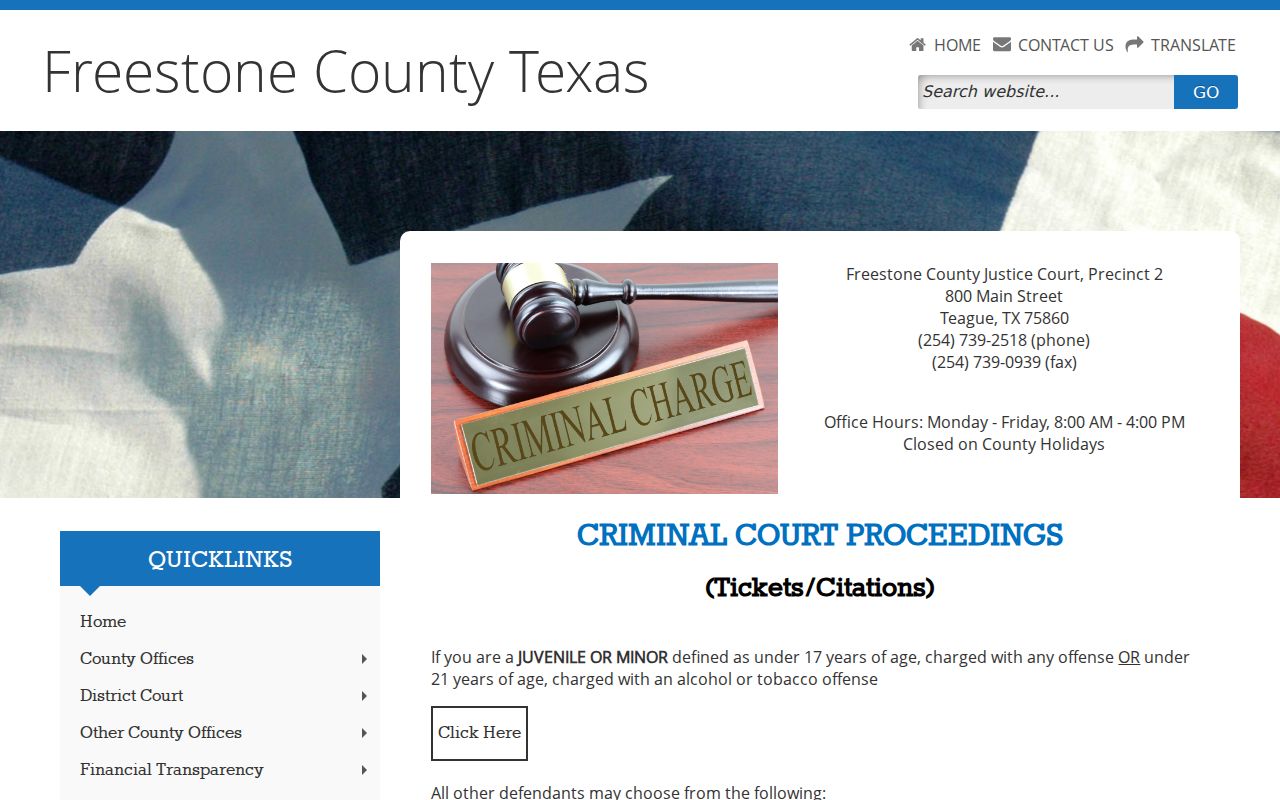
A lower-court file must go through its own clerk. A district docket search will not reach it.
Freestone Calendar Versus Register
A calendar tells you who is set, when, and for what event. A register tells you what was filed and entered over time. A Freestone criminal PDF can list case number, setting, offense, bond, and attorney but still omit documents, balances, or final status.
| Source | Best use | Limit |
|---|---|---|
| County PDF | Find a date | Changeable snapshot |
| re:SearchTX | Search integrated cases | Criminal documents limited |
| Clerk register | Trace events | Direct request may be needed |
| Certified judgment | Prove the outcome | Separate copy process |
Search the docket first to find the case, then let the clerk's record back it up. When you need a filed order in hand, the Freestone court case records workflow is the next step.
Public Access and Sealed Criminal Dockets
Even open criminal docket information can be sealed, expunged, kept confidential, or redacted. Juvenile files get extra care. A blank result can mean restricted access, a file too old, incomplete data sharing, or simply the wrong court, so it does not settle anything on its own.
Key rules:
Texas Judicial Branch access policy distinguishes court case records from judicial administrative records.
Texas Rule of Judicial Administration 12 governs defined judicial records and exclusions.
Texas Family Code Section 58.007 protects juvenile justice information.
Ask the clerk if a public docket entry, a redacted copy, or some other public version exists. A search result alone proves neither guilt nor secrecy.
Confirm Freestone Criminal Settings
If dates conflict, reload the county page instead of trusting a cached PDF. District trial settings belong to the coordinator. District filings go to the District Clerk, and County Court misdemeanor dates to the County Judge office. Class C matters belong to the named JP or city court. Have the cause number ready, plus the case style, the prior date, and the setting label. Ask if the event was reset, passed, canceled, or replaced by an order. Also confirm the room and how you appear. No county source states one remote-hearing rule for all courts. Want written proof? Request the notice or order itself. That last step tells a live docket fact apart from a stale calendar snapshot.
Freestone Criminal Judgment Requests
A calendar entry that shows only a setting is not the outcome, so ask the clerk who owns the case for the judgment, dismissal, or signed order. Give the cause number and say whether a plain or certified copy is needed. County misdemeanors go through the County Clerk. Felonies go through the District Clerk. Final terms live in the document, not in calendar shorthand. For mail or counter service, name the court, the document, and the date range. Settle cost and payment before you order. Freestone courts do not publish one criminal-copy fee that covers them all, so ask first.