
How to Search Civil Dockets
Start with the claim and the court level. District civil, family, land, and title matters go to the 77th or 87th District Court. Records there sit with the District Clerk. County civil and probate matters go to the constitutional County Court and the County Clerk. Small claims, debt claims, and evictions belong to a justice court. Ordinary civil suits never start in municipal court.
The Freestone County Dockets page posts date and setting PDFs. It offers no single public form for searching every civil case. You cannot search by name or cause number there in one sweep. For trial dates, the District Court Coordinator’s live setting links can help. re:SearchTX may return cases, filings, text, and hearings for courts that are integrated with it.
- Identify the claim, amount, property location, and court shown on notices.
- Use the county PDF or re:SearchTX for the matching court.
- Search with the exact cause number and full case style.
- Read filings, orders, settings, and disposition in date order.
- Ask the responsible clerk for missing or certified documents.
If the docket search comes up empty online, go to the clerk. The District Clerk, County Clerk, or precinct clerk can check the civil docket by phone or at the counter. A mailed request works too. Give the cause number, the court, the document, the date range, and the copy type you need.
Three Freestone Civil Searches
District, county, and justice dockets are separate record systems. That split follows jurisdiction, not filing preference. A family or title case can belong in District Court, while probate and county civil work can belong in County Court. A money claim within a justice court’s authority may stay in a precinct court from filing all the way through judgment.
| Civil matter | Court | Custodian |
|---|---|---|
| District civil, family, land | 77th or 87th District Court | District Clerk |
| County civil or probate | County Court | County Clerk |
| Small claims, debt, eviction | JP precinct | Justice court clerk |
Let the court printed on the citation, order, or file-stamped pleading control where you search. If you are unsure, describe the claim to the clerk instead of asking only for “civil records.”
What a Civil Docket Shows
The county’s all-case PDF lists case number, time or setting, party style, and attorney fields. It is not a civil-only register. A clerk’s fuller court record can add the filing date, case type, party roles, pleadings, service, answers, motions, notices, orders, hearings, judgment, appeal, writs, and cost events. So confirm each field with the clerk. The static PDF may not display everything.
| Cause number | The local identifier; preserve its exact punctuation and prefix. |
|---|---|
| Case style | The names and roles in the caption. |
| Filing event | A petition, answer, motion, notice, order, or other entry. |
| Setting | A future hearing or trial date, not the outcome. |
| Disposition | The result shown by an order or judgment. |
| Post-judgment event | An abstract, writ, release, satisfaction, appeal, or mandate. |
Read entries for what they are. A filed petition is not a judgment, and a citation issued is not proof of service. A motion merely asks for relief; the order states what the court actually directed.
Freestone JP Civil Boundary
JP1 puts its civil jurisdiction at $20,000, excluding interest and costs. Small claims seek money damages. Evictions are filed where the property lies. That is why a dispute can have a Freestone County civil docket without ever appearing in District Court or a County Court PDF.
Routing point: A small claim or eviction is a justice-court search. The property location and precinct matter as much as a party name.
The JP3 forms catalog covers debt claims, evictions, small claims, answers, military affidavits, nonsuits, appeal bonds, releases of judgment, writs of execution, and writs of possession. A blank form proves only that a procedure exists. It does not prove the form was filed in any case.
Types of Civil Cases on the Docket
Civil docket labels can hide very different routes. Contract and tort cases may be district or county matters, depending on jurisdiction. Family cases generally route through District Court. Probate can involve wills, estate administration, guardianships, mental-health proceedings, citations, letters, and writs at the County Clerk, while land and title litigation is not the same thing as a recorded land instrument.
| Type | Likely route | Useful request |
|---|---|---|
| Family or title suit | District Court | Register and signed order |
| Probate or guardianship | County Court | Cause file, letters, or order |
| Small claim or debt | Justice court | Docket and judgment |
| Eviction | Justice precinct for property | Docket, judgment, writ status |
| Recorded abstract | County Clerk land records | Instrument image and number |
When you contact a clerk, name the proceeding and the paper you want. That helps the clerk tell a probate order from a district family order or a recorded abstract.
Freestone Civil Filing Sequence
A civil docket reads best as a sequence. The plaintiff or petitioner starts with a pleading. Citation and service then notify the other side. An answer responds. Motions request action, notices set hearings, and orders decide the requests. A judgment resolves the issues. Later writ, abstract, release, or appeal entries concern enforcement or review.
Record flow: Petition › Citation and Service › Answer › Motions › Setting › Order or Judgment › Enforcement or Appeal
- Nonsuit
- A voluntary withdrawal by the filing party, subject to Texas procedure.
- DWOP
- Dismissal for want of prosecution, not a merits ruling.
- Default judgment
- A judgment after a required answer or appearance was not made.
- Abstract
- A recorded summary of a judgment.
When the exact wording matters, always pull the signed order. A terse “disposed” label cannot show whether the result was a nonsuit, default, agreed judgment, dismissal, or final judgment on the merits.
Settings and Hearings on Civil Dockets
A notice of setting is a future event, not a ruling. Freestone County PDFs can list time and setting. The coordinator’s route may be more current for district trials, though. Compare the PDF date against later notices and orders. County files expressly warn that settings may change.
For a district hearing, call the coordinator at (903) 389-4836. For filed papers, use the District Clerk at (903) 389-2534. County civil or probate questions go to the County Clerk at (903) 389-2635. JP1 is (903) 389-8783, JP2 is (254) 739-2518, and JP3 is (903) 389-3137. Directory details for JP4 conflict, so verify its current number before filing.
Ask whether the hearing is in person or remote. Ask which room applies. Ask whether a reset order exists, too. Freestone County has no universal remote-hearing rule.
Freestone Land Portal Limits
The County Clerk links a publicsearch.us portal. It holds indexed and imaged land and public records from 1933 forward. Printing runs $1 per page. A credit card is required. Material older than that, from 1851 through 1933, goes through the copydesk route instead. That channel matters when a civil docket points to an abstract, release, or another recorded instrument. The portal is not a civil pleading database.
A recorded abstract and the lawsuit beneath it carry different identifiers. Keep the civil cause number for the court case. Keep the instrument number for the county record. Asking for both keeps a judgment from getting lost on its way into the land records. The office’s official County Clerk source lays out the record routes. It also posts the copy notices the clerk actually offers.
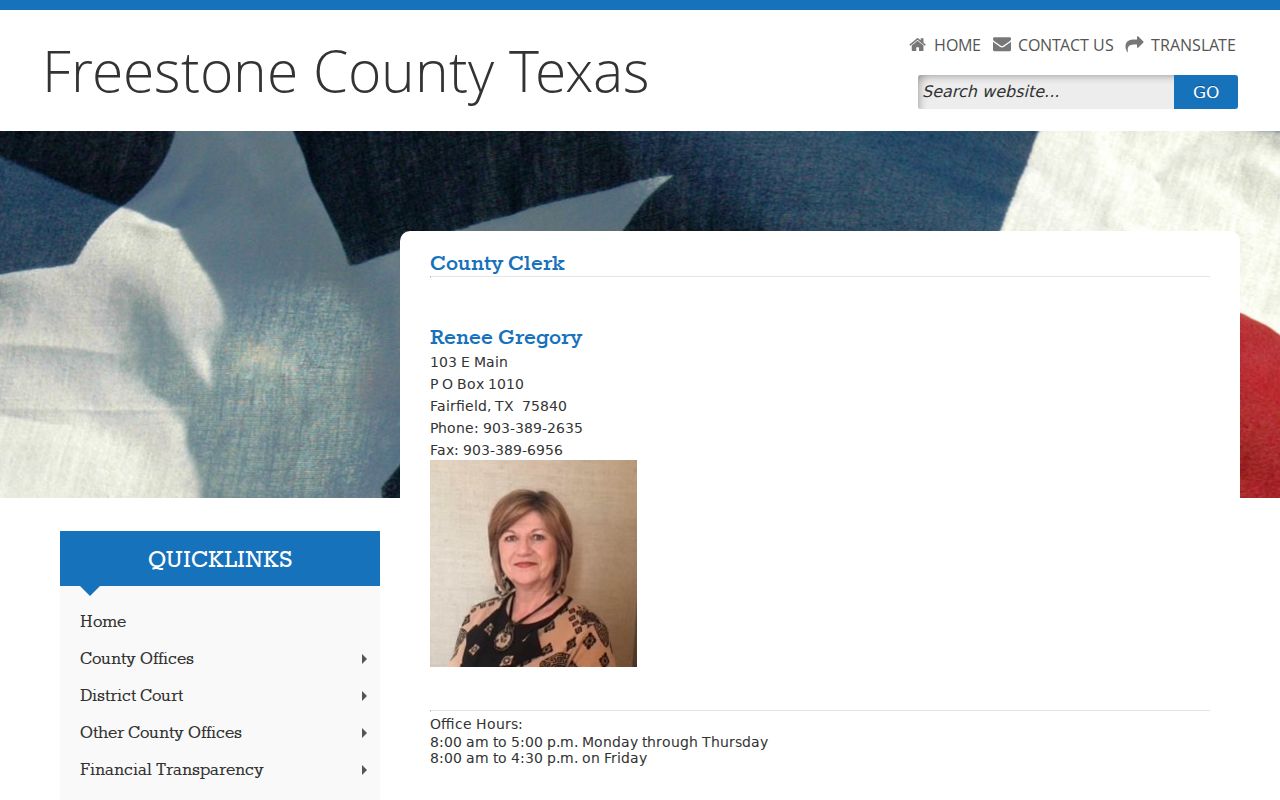
The office’s own page sorts out the difference. It separates the clerk’s land, probate, and county civil services from the District Clerk’s case files.
Public Access to Civil Dockets
Civil court records are generally open in Freestone County. Still, some files can be closed off. A sealing order, juvenile or family confidentiality, or sensitive-data redaction can shut a file or part of one. Texas Rule of Civil Procedure 76a sets an open-record presumption for court records. It also sets a process for sealing them. The rule does not force every exhibit or identifier into public view.
Access rule: Review the Texas Rules of Civil Procedure for Rule 76a and redaction requirements. Ask the clerk whether a public or redacted version can be released.
The Texas Public Information Act does not simply govern every judicial case record. The Judicial Branch access policy explains where the line falls. So a missing online document may be sealed, restricted, archived, or simply absent from the portal.
Older Freestone Civil Files
For an older Freestone County civil case, the first question is which clerk owned it. Then give the court. Provide the full cause number, the party style, the approximate year, a date range, and the exact document sought. Ask whether the file is imaged, archived, restricted, or only available at the counter. Also say whether a plain or certified copy is needed. That way the clerk can calculate the charge before you commit.
FY2024 state statistics put the scale in view. Freestone district courts began with 1,382 civil cases. They added 197, disposed of 143, and ended with 1,436. Family cases began at 1,372. They added 131, disposed of 92, and ended at 1,411. Those totals track separate docket streams, not any single case, so they cannot locate one.
Use statistics for context and the clerk’s register for proof. The Freestone docket search routes name and number lookups, while a copy request pulls the document behind the result.
Freestone Civil Judgment Proof
A docket label rarely proves what a civil judgment actually says. Request the signed judgment from whichever office owns the case, whether the District Clerk, the County Clerk, or a justice court. Say up front if you need certification. When enforcement produced an abstract or release in the land records, request that instrument separately and hold onto both identifiers.
Why two records? A court judgment and a later county recording are different things, and keeping them apart preserves the exact terms of dismissal, default, agreement, costs, and post-judgment relief.